Today, you will learn what IRMAA is and how to calculate IRMAA. This article is the ultimate playbook for the 2026 IRMAA brackets.
By reading this article on 2026 IRMAA brackets, you could save up to $6,936 per year on unnecessary IRMAA surcharges. The best part is that taking action to avoid this Medicare Part B and Part D surcharge is not that hard.
Ready to get started?
This article will teach you everything about the 2026 IRMAA tax brackets. I will also provide a few calculators you can use to reduce or avoid IRMAA.
I'm also sharing the following:
- How to appeal IRMAA
- If foreign income counts towards the IRMAA surcharge calculation.
What is Medicare IRMAA?
The income-related monthly adjusted amount (IRMAA) is an added fee for Medicare premiums if your Modified Adjusted Gross Income (MAGI) exceeds a certain threshold. The Social Security Administration determines the brackets and fees.
I know you thought IRMAA was the name of your distant prima (cousin), but it's not. In plain English, IRMAA is an added "tax" for retirees on their monthly Medicare part B and D premiums if they make too much money.
The surcharge for Medicare premiums can be avoided or reduced with careful planning and understanding of IRMAA; let's explore how.
How is IRMAA Calculated?
IRMAA is determined based on your Modified Adjusted Gross Income (MAGI) from two years ago.
Put differently, 2026 tax brackets are determined based on your MAGI for 2024.
Today, I will help you figure out how to calculate MAGI to avoid or eliminate the IRMAA surcharge.
How to Calculate MAGI for IRMAA
To calculate MAGI for 2026 IRMAA brackets, look for your 2024 tax return and locate your adjusted gross income, line item 11.
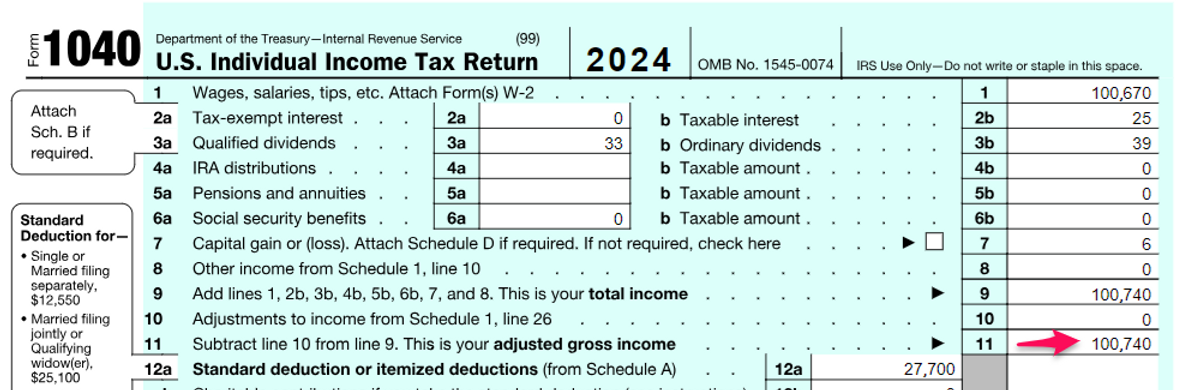
Pro tip: Looking at tax forms can be daunting, but don't worry; it's easy. Look at the top of each page on your tax return to find Form 1040. That's the one with the information you need for your calculation.
From there, you can calculate your IRMAA MAGI by adding back the following items:
- Earned income of U.S. citizens living abroad that was excluded from gross income.
- You can find this on Form 2555.
- Interest from U.S. savings bonds used to pay higher education tuition and fees.
- Income sources within Guam, American Samoa, The Northern Mariana Islands, or Puerto Rico.
- Tax-exempt interest like municipal bond income.
- You can find this on Line 2a of your tax return.
Once you have done the simple math, you can refer to the IRMAA brackets to determine your 2026 IRMAA surcharge, if any.
Does the Income I Earn Abroad Affect IRMAA?
Yep, If you work in Mexico, Colombia, or any country, your earned income may affect your Medicare premiums because it's an adjustment to your Adjusted Gross Income when determining your IRMA MAGI.
- See How to Calculate MAGI for IRMAA to learn more.
Calculators for IRMAA
Below are some calculators that can help you figure out your MAGI for IRMAA.
- This one has a cost, but it offers other features to help you with the rest of your retirement planning.
- This one only works on iPhones, but it is free.
What Are the 2026 IRMAA Medicare Brackets?
There are a total of five IRMAA brackets. The maximum IRMAA surcharge in 2026 is $487 per month, on top of the base rate of $202.90.
Heads up! The income used to calculate your 2026 IRMAA is always your MAGI from two years prior. In this case, it would be your 2024 MAGI.
To simplify, here is what you need to know about the 2026 IRMA brackets.
- For single filers or those married and filing separately, if you earn over $109,000+, you will be subject to the Medicare surcharge.
- For married couples filing jointly, if your combined income is over $218,000+, you will be subject to the Medicare surcharge.
The 2026 IRMAA brackets for Medicare Part B and D are below.
.png)
You can find historical IRMAA brackets for Medicare Part B and Pat B by clicking here.
Appealing IRMAA Medicare Surcharges
You can appeal IRMAA surcharges using form SSA-44 or by calling the Social Security Administration at (800) 772-1213. Before starting the appeal process, you must wait for your IRMAA determination letter.
If you submit Form SSA-44, you must attach evidence of the life-changing event and potentially show original documents or certified copies.
It's important to only choose one life-changing event on the list. If you have experienced more than one, you'll want to call your local Social Security office.
How to File an IRMAA Appeal
To start the appeal process, you must follow the steps below promptly.
- File an appeal within 60 days of receipt of an IRMAA determination notice.
- Typically, they assume you received the notice 5 days after the date on the notice unless you can show you did not receive it within the 5 days.
- If you file an appeal outside that timeframe, you must have "good cause."
Common Reasons to File an IRMAA Appeal
The Social Security Administration has defined eight life-changing events that qualify you to appeal an IRMAA surcharge. Below is a list of the eight circumstances.
- Marriage
- Divorce/Annulment
- Death of your spouse
- Work stoppage
- Work reduction
- Loss of income-producing property
- Loss of pension income
- Employer settlement payment
Another common reason to file an IRMAA appeal is to have the Social Security Administration recalculate your IRMAA surcharge due to an amended tax return.
What Happens If the IRMAA Appeal Is Denied?
No need to lose your cool and start blaming your favorite political officials; we already have enough reasons to do that. If your appeal gets denied, you can go through four levels of appeal.
Check out the list of the four IRMAA appeal levels below.
- A reconsideration which is processed by the Field Office
- A Hearing before a Department of Health and Human Services (DHHS) Administrative Law Judge (ALJ) in the Office of Medicare Hearings and Appeals (OMHA)
- A review by the DHHS Medicare Appeals Council (MAC); and
- Federal Court Action.
Useful IRMAA Case Studies
Let's review some case studies of IRMAA brackets and real-life appeal scenarios
Case Study #1: Appeal - Oscar (Individual Tax Payer)
Situation: Oscar retired in late 2024. Because his income dropped sharply, he filed Form SSA-44 in early 2025 to have his Medicare premium reset — but a 2026 IRMAA surcharge notice still showed up based on his higher pre-retirement income.
- 2024 income (his final working year): $180,000
- Post-retirement income: $95,000
- Medicare approved a favorable adjustment based on his reduced income
Explanation: Retirement is one of eight qualifying life-changing events that can support an IRMAA appeal. Medicare premiums are normally set two years back — your 2026 premium is based on your 2024 MAGI. That lookback is exactly why retirees get blindsided: the income on file is from your last working year, not your new retirement income. Oscar's $180,000 in 2024 MAGI put him in the $171,001–$205,000 single-filer bracket — a $324.60 monthly Part B surcharge plus a $60.40 Part D surcharge. His actual post-retirement income of $95,000 falls below the $109,000 threshold, where no surcharge applies at all. He filed Form SSA-44 to have Social Security use his current, lower income instead of the stale 2024 figure, and the adjustment was approved.
Outcome: The next year, a new notice arrived reassessing 2026 based on the old, higher income — as if the adjustment had never happened. Oscar called the Social Security office, pointed to the adjustment already on record, and asked for the same treatment. They corrected it on the call. If this happens to you, the surcharge isn't necessarily final, a phone call is often all it takes.
Case Study # 2: Planning Ahead - Martha (Joint Filing Married Tax Payer)
Situation: In 2026, Martha wants to do a Roth conversion but is worried about how it will affect her Medicare premiums in 2028 — Medicare premiums are set two years back, so a conversion done today shows up on her IRMAA bill the year after next.
Facts:
- Martha is 63 in 2026 and files a joint tax return
- 2026 income (before conversion): $170,000
- She's looking to convert $80,000
Explanation: The amount converted from a traditional IRA to a Roth IRA counts as taxable income and flows into your adjusted gross income (line 11 of Form 1040). Your AGI is the starting point for calculating the Modified Adjusted Gross Income (MAGI) that determines IRMAA surcharges. Using the 2026 IRMAA brackets above, we can see the conversion would push Martha well past the $218,000 threshold for joint filers — her $170,000 base income plus an $80,000 conversion puts her at $250,000, landing her in the $218,001–$274,000 bracket. That means a $81.20 monthly Part B surcharge and a $14.50 monthly Part D surcharge for 2028, on top of whatever else shows up in her MAGI that year.
Outcome: She and her financial advisor decided to convert $35k instead of $80k to keep her from being hit with IRMAA in 2026, when she became eligible for Medicare.
Case Study #3: Using IRMAA Brackets - Gloria (Filing Single)
Situation: Gloria wants to know if she'll be subject to IRMAA in 2026.
Facts:
- Her income was $95,000 in 2024 (the year Medicare looks back to for 2026 premiums)
Explanation: Using the 2026 IRMAA brackets below, we can see she won't be subject to IRMAA in 2026 because her income falls below the $109,000 threshold for individual filers.
Outcome: Her 2026 Medicare Part B premium will be $202.90 per month — the standard rate, with no surcharge — and her Medicare Part D premium will be whatever her plan provider charges, also with no surcharge added.
The 4 Best Ways to Reduce (or Avoid) IRMAA
This guide is designed to assist you in decreasing or eliminating IRMAA. The strategy is to lower your Modified Adjusted Gross Income (MAGI) to avoid or reduce IRMAA.
There are many ways to reduce your taxes. Below you will find the four best ways to lower your income (MAGI) and help you avoid IRMAA.
1) Charitable Gifting
Gifting to your church or nonprofit can be joyful and save money on taxes. However, giving cash is one of the worst ways to donate since it does not lower your MAGI.
Here's how to gift instead.
Gifting Appreciated Investments
Do you have investments like mutual funds, bonds, ETFs, stocks, or real estate?
Gifting these types of investments can be a smart move because it helps you avoid paying extra taxes on any profits you made from them, and it lowers your Adjusted Gross Income (AGI).
Here are a few things you should know about giving investments as gifts:
- The amount of the gift is based on how much the investment is worth when you give it away.
- One cool thing about this strategy is that if you list all your deductions when you do your taxes, you can lower your taxable income.
- By giving investments as gifts, you can avoid paying extra taxes on the money you made, which can help you reduce or even eliminate IRMAA for this year or in the future.
In plain English, by gifting appreciated investments, you avoid capital gains that can help you reduce or eliminate IRMAA in the current or future tax years.
Qualified Charitable Distributions (QCDs)
A Qualified Charitable Distribution (QCD) is a tax provision that allows individuals aged 70½ or older to donate up to $100,000 per year directly from their Traditional IRA to eligible charitable organizations.
Gifting to a charity with a Qualified Charitable Distribution (QCD) from your Traditional IRA reduces your Required Minimum Distributions (RMDs) and can lower your Modified Adjusted Gross Income (MAGI), helping you manage Medicare's Income-Related Monthly Adjustment Amount (IRMAA).
Another strategy to use QCDs is to gift your Required Minimum Distribution instead of taking it as cash, which lowers your MAGI for IRMAA.
Best of all, you do not pay taxes on any QCD as long as you do it correctly. To do it correctly, the custodian of your IRA (the company where your IRA is held) must send the money directly to the charity. Make sure the money never hits your bank account.
2) Roth Conversion
A Roth IRA conversion is when you change money from a specific type of retirement account called a Traditional IRA into a different kind of retirement account called a Roth IRA. People do this because a Roth IRA has some unique benefits.
One of the benefits of doing a Roth IRA conversion is that it can help you lower the amount of money you're required to withdraw from your retirement account each year when you're older. This is called the Required Minimum Distribution (RMD). By doing a conversion, you can reduce your RMD and, as a result, lower your Modified Adjusted Gross Income (MAGI) for IRMAA.
In simpler terms, A Roth IRA conversion can lower future healthcare costs by avoiding mandatory withdrawals from retirement accounts. It's a smart income management strategy.
3) Tax-Efficient Withdrawal Strategies
As a financial planner, I often notice many rely solely on their CPAs or accountant to help with their taxes. However, accountants typically focus on preparing the tax return for the current year and often do not look into opportunities to plan for future tax savings.
For example, when you retire or have a lower income year, selling investments that have gained value before the year ends can result in paying zero percent capital gains tax instead of the usual 15% or 20%.
Now, let me ask you a question: When was the last time your accountant told you how much to withdraw from your Traditional IRA, Roth IRA, 401(k), or taxable account to pay the least taxes?
It's essential to consider the different types of accounts you own and how they are taxed when planning your retirement income. By strategizing which accounts to withdraw from, you can optimize your tax situation and save more money in the long run.
The key takeaway is that taking a proactive approach to tax planning, beyond just filing your tax return, can uncover opportunities for significant tax savings and help you reduce your MAGI for IRMAA.
4) IRMAA Life-Changing Events
You can have your IRMAA surcharge reconsidered if you have experienced any of the life-changing events below.
%401x.png)
What Action Will You Take?
In planning for retirement, it's essential to recognize that every action has a reaction. This applies to understanding the intricacies of IRMAA brackets (Medicare Part B and Part D premium surcharges based on income) and taking proactive steps to plan for the years ahead.
However, it's essential to note that willingly accepting to pay IRMAA surcharges for a few years can be a good idea. There are instances where choosing to pay a few extra thousand dollars in IRMAA surcharges can result in significant savings of tens of thousands in the future.
The key message here is that by carefully considering the details of IRMAA brackets and engaging in proactive planning, you can make informed decisions that align with your long-term financial goals. This approach allows you to retain more of your hard-earned money throughout your retirement journey.
I'm all about taking action; what action will you take to lower or avoid your IRMAA surcharge?